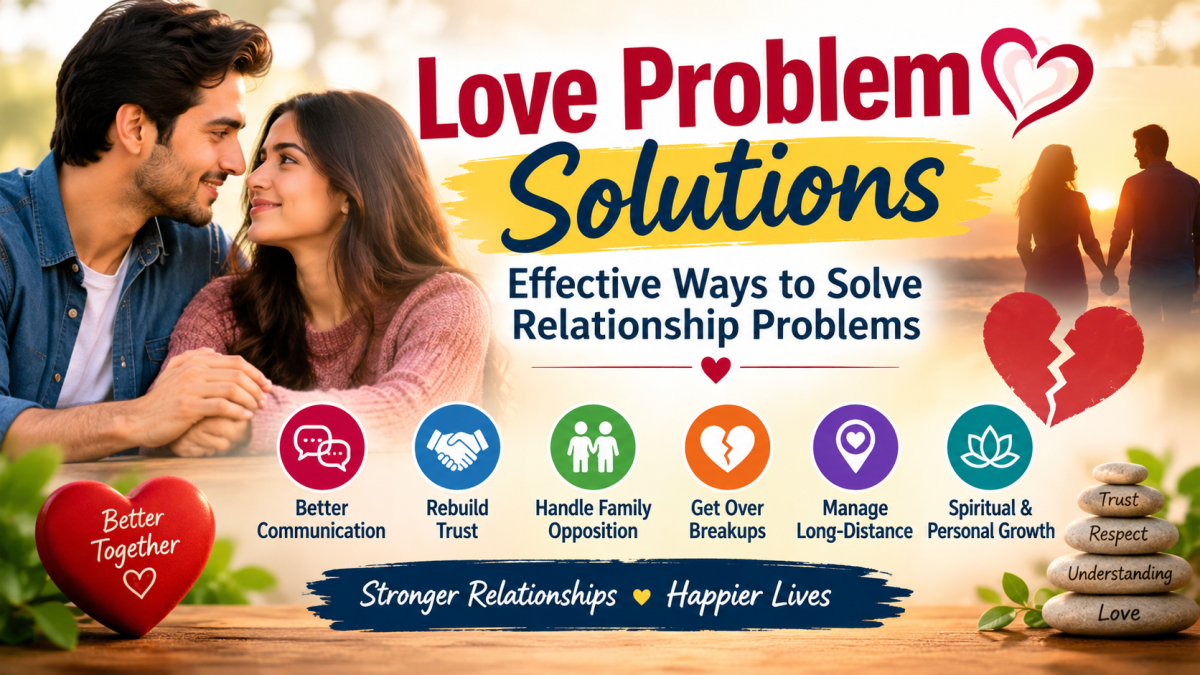
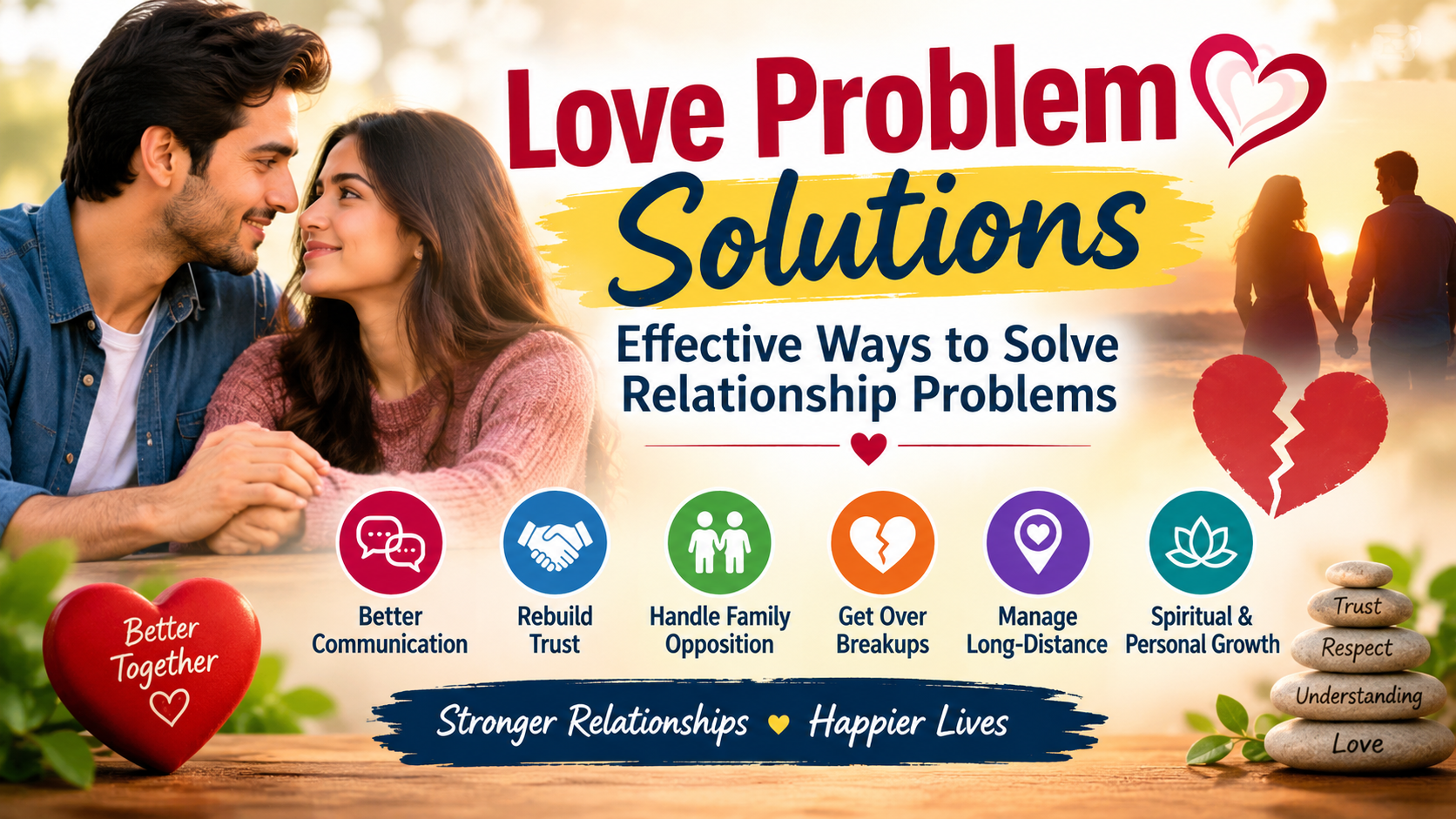
Love relationships can bring happiness, emotional support, and companionship, but they can also go through difficult phases. Misunderstandings, frequent arguments, family opposition, communication gaps, jealousy, long-distance challenges, breakups, and emotional distance can create serious stress between two people.
When a relationship starts experiencing problems, many people search for Love Problem Solutions that can help them understand the situation and rebuild trust. The most effective approach is usually not a single remedy but a combination of honest communication, emotional understanding, patience, healthy boundaries, and practical action.
This guide explains effective ways to deal with common love and relationship problems and provides practical steps that couples can consider.
What Are Common Love Problems?
Every relationship is different, but many couples experience similar challenges. Some of the most common love problems include:
- Frequent arguments and disagreements
- Lack of communication
- Loss of trust
- Jealousy or insecurity
- Emotional distance
- Breakup or separation
- Family opposition to the relationship
- Long-distance relationship difficulties
- Differences in expectations
- Problems related to marriage decisions
- Interference from friends or relatives
- Difficulty forgiving past mistakes
Understanding the actual cause of a problem is the first step toward finding an appropriate solution.
1. Identify the Real Cause of the Problem
One of the most important love problem solutions is to identify what is actually creating conflict.
For example, a couple may argue about small things every day, but the real problem may be a lack of trust or unresolved hurt from the past. Similarly, emotional distance may not necessarily mean that love has disappeared. It can sometimes be connected to stress, work pressure, family circumstances, or poor communication.
Before taking any major step, ask yourself:
- When did the problem begin?
- What usually triggers arguments?
- Have there been repeated misunderstandings?
- Has trust been affected?
- Are both partners willing to work on the relationship?
- Are external circumstances contributing to the problem?
Answering these questions can help you focus on the underlying issue rather than only reacting to individual arguments.
2. Improve Communication Between Partners
Communication is one of the foundations of a healthy relationship.
When couples stop discussing their feelings openly, misunderstandings can grow. Instead of assuming what your partner thinks, try to have a calm conversation.
Choose an appropriate time when neither person is angry or distracted. Explain your feelings without attacking the other person.
Instead of saying:
“You never understand me.”
Try:
“I feel hurt when we don’t discuss important things with each other.”
This small change can make conversations less confrontational.
Good communication involves both speaking and listening. Allow your partner to explain their perspective without immediately interrupting or preparing a counterargument.
To Know More about : First Love Back Solution
3. Rebuild Trust Step by Step
Trust can take a long time to build and can be damaged quickly.
If your relationship has experienced dishonesty, broken promises, secrecy, or another serious issue, rebuilding trust requires consistent behavior rather than only apologies.
Useful steps can include:
- Be honest about what happened.
- Accept responsibility for your actions.
- Avoid repeating the behavior that caused the damage.
- Give your partner reasonable time to process their feelings.
- Keep promises and commitments.
- Communicate openly about important concerns.
Trust cannot normally be restored through pressure. Both people need to feel comfortable participating in the process.
4. Give Each Other Space
Sometimes people try to solve relationship problems by constantly calling, texting, or demanding immediate answers. This can increase pressure rather than resolve the issue.
Healthy relationships require emotional connection as well as individual space.
If your partner needs time to think, allowing reasonable space can help both people calm down. Space does not necessarily mean ending the relationship. It can provide an opportunity to reflect on what each person actually wants.
However, space should not be used as a tool for punishment, manipulation, or deliberately creating anxiety.
5. Avoid Arguments During Emotional Moments
When emotions are extremely high, even a small disagreement can become a major argument.
If a conversation is becoming aggressive, consider taking a short break and returning to the issue later when both people are calmer.
During disagreements, avoid:
- Insults
- Threats
- Personal attacks
- Bringing up every old mistake
- Publicly humiliating your partner
- Sending angry messages repeatedly
The goal of a relationship discussion should be to understand the problem and find a solution—not to determine who can hurt the other person more.
6. Dealing With Breakup and Separation
A breakup can be emotionally difficult, especially when one person still wants the relationship to continue.
If you hope to reconnect with an ex-partner, the first step should be understanding why the relationship ended.
Ask yourself:
- What caused the breakup?
- Was the issue temporary or long-term?
- What mistakes did each person make?
- Has anything actually changed since the breakup?
- Does the other person want communication or reconciliation?
If both people are willing to communicate, a respectful conversation may help clarify whether rebuilding the relationship is realistic.
However, reconciliation cannot be forced. A healthy relationship requires the voluntary participation of both individuals.
Repeatedly contacting someone who has clearly asked for no contact can make the situation worse. Respecting boundaries is important even when emotions are strong.
7. Handling Family Opposition to Love
Family disagreement is another common relationship challenge, particularly when a couple is considering marriage.
Family concerns may involve:
- Cultural differences
- Financial concerns
- Education or career
- Social expectations
- Different family backgrounds
- Fear about the future
- Personal disagreements
Instead of immediately turning the situation into a confrontation, try to understand the specific concern.
A calm discussion can sometimes be more productive than an emotional argument. If appropriate, a trusted and neutral family member can also help facilitate communication.
Couples should also discuss practical matters with each other, including finances, careers, living arrangements, family responsibilities, and expectations after marriage.
8. Managing Jealousy and Insecurity
A certain amount of insecurity can occur in relationships, but excessive jealousy can create serious problems.
If jealousy is affecting your relationship, try to understand its source.
Is it caused by:
- Previous betrayal?
- Lack of communication?
- Fear of losing the relationship?
- Negative past experiences?
- Unclear boundaries?
Partners can discuss reasonable boundaries around friendships, social media, communication, and privacy.
Healthy boundaries should be mutually agreed upon rather than imposed through control.
Checking someone’s phone without permission, tracking their location constantly, or restricting who they can talk to are not healthy substitutes for trust.
9. Relationship Problems in Long-Distance Love
Long-distance relationships can be challenging because partners cannot spend regular physical time together.
A practical approach is to establish realistic communication habits.
For example, couples may decide to have regular calls instead of expecting constant texting throughout the day.
It can also help to discuss:
- When you will meet next
- How often you want to communicate
- How to handle disagreements
- Future plans for living in the same location
- Career and family considerations
A long-distance relationship becomes easier when both partners have clarity about where the relationship is heading.
10. Consider Professional Relationship Counseling
Sometimes couples repeatedly experience the same problems despite trying to communicate.
In such situations, relationship counseling or couples therapy may be worth considering. A qualified professional can provide a structured environment where both partners can express their concerns and learn healthier communication techniques.
Professional support can be particularly useful when couples are dealing with serious trust issues, repeated conflict, major life decisions, or difficulty communicating.
Seeking help does not automatically mean that a relationship has failed. It can simply mean that the couple wants additional support.
11. Traditional or Spiritual Remedies
Many people also explore spiritual or traditional remedies for love problems, particularly in cultures where astrology, prayer, meditation, rituals, or other spiritual practices are important.
Such practices can have personal or cultural significance and may help some people feel calmer, more hopeful, or more focused.
However, spiritual practices should not be presented as guaranteed methods for controlling another person’s feelings or forcing someone to return to a relationship.
If you follow a traditional practice, it is sensible to combine it with practical steps such as communication, self-reflection, counseling, and respect for personal boundaries.
The healthiest goal is not to control another person but to create the conditions for mutual understanding and voluntary connection.
12. Focus on Personal Growth
Relationship problems can sometimes reveal areas where personal growth is needed.
Consider working on:
- Emotional regulation
- Patience
- Communication skills
- Self-confidence
- Listening skills
- Managing expectations
- Setting healthy boundaries
- Learning from previous mistakes
Personal growth benefits you regardless of whether a particular relationship continues.
A relationship should ideally involve two people who are choosing to support each other’s growth rather than trying to control each other.
When Should You Seek Immediate Help?
Some relationship problems are more serious than ordinary disagreements.
If a relationship involves physical violence, threats, coercion, stalking, sexual pressure, financial control, or serious emotional abuse, the priority should be safety rather than reconciliation.
In such circumstances, consider reaching out to a trusted person or an appropriate professional or local support service.
No relationship problem justifies violence or coercive behavior.
Frequently Asked Questions About Love Problem Solutions
Can love problems be solved?
Many relationship problems can improve when both partners are willing to communicate, understand the underlying issue, and make consistent changes. However, no method can guarantee that another person will remain in or return to a relationship.
What is the first step in solving a relationship problem?
The first step is usually identifying the actual cause of the conflict. Once the cause is understood, partners can decide whether communication, boundaries, counseling, or another practical approach is appropriate.
Can communication help after a breakup?
Sometimes. If both people are comfortable communicating, a respectful conversation can help clarify what happened and whether reconciliation is possible. If someone has requested no contact, that boundary should be respected.
Are spiritual remedies useful for relationship problems?
Spiritual or traditional practices can provide personal comfort, reflection, or emotional support. They should complement—not replace—healthy communication and practical relationship efforts.
Final Thoughts
Love problems can be emotionally challenging, but reacting impulsively is rarely helpful. Whether the issue involves frequent arguments, separation, family opposition, jealousy, communication problems, or uncertainty about the future, understanding the underlying cause is an important starting point.
Effective love problem solutions generally involve honest communication, patience, trust-building, healthy boundaries, personal growth, and—when necessary—professional guidance.
Most importantly, a healthy relationship depends on mutual choice and respect. Rather than trying to control another person’s emotions or decisions, focus on creating an environment where both partners can communicate openly, understand each other, and decide freely what they want for the future.
When both people genuinely want to work on the relationship, consistent effort and respectful communication can provide a meaningful foundation for positive change.